

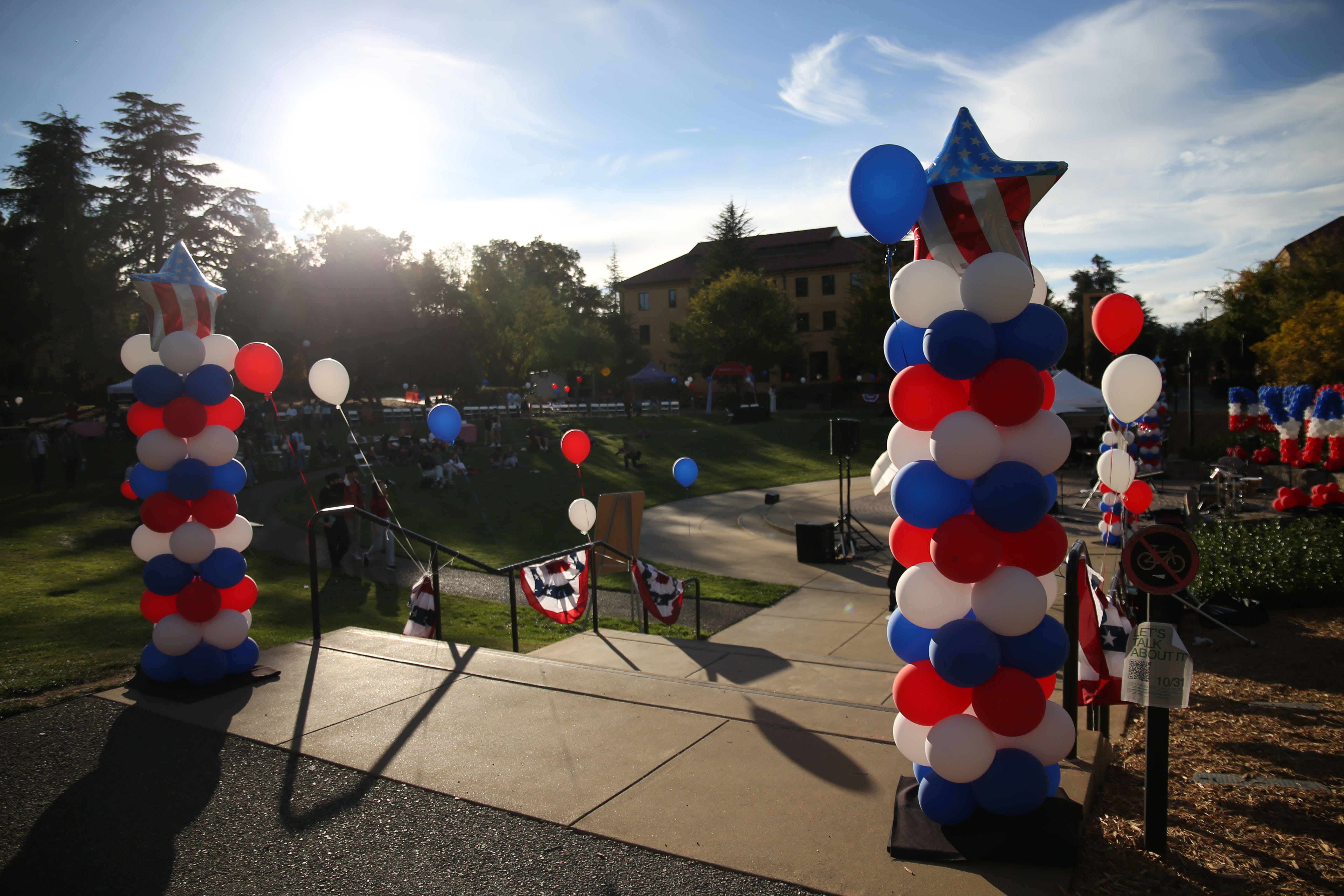
This November will mark the sixth anniversary of Stanford’s civic holiday, Democracy Day. Established by the Faculty Senate in the wake of the January 6 attack on the US Capitol, Democracy Day seeks to reinforce democratic values among students by encouraging voting and civic engagement. Since then, students have had no classes on Election Day, which lands at the height of midterms and a few weeks before Thanksgiving break. But if Democracy Day is to survive, it must not be a day off from classes; learning and voting need not be mutually exclusive.
To be clear, I will not argue for the abolition of Democracy Day. The idea of college students organizing to promote civic engagement is, in my view, both beautiful and important in today’s political climate.
With that said, Democracy Day has a mixed record. Even as some faculty praise it in public, behind closed doors others have called for scrapping the holiday altogether, citing low turnout and the sacrifice of valuable class time for poorly attended events. As a member of last year’s Democracy Day executive team, I can attest that organizers are well aware of the Daily’s pessimistic coverage, highlighting low attendance and empty seats at main events. It also doesn’t help that the holiday’s past success remains vague, turning out a dubious “thousands” of students while increasing the number of events to signal growth.
Given these shortcomings, it seems clear that Democracy Day needs to be reformed. Fortunately, the solution is simple: classes should not be canceled on Democracy Day. Freed from the burden of lectures, the majority of students will continue to take advantage of the day off: some make a beeline for Half Moon Bay, while others catch up on sleep and homework. Those who do so are not necessarily politically disengaged; in fact, many of my most politically minded friends haven’t attended a single Democracy Day event. Given the exigencies of the quarter system, which rarely grants students a chance to catch their breath, taking advantage of the day off to catch up on work or get off campus seems reasonable, even to the most diligent of students.
By restoring classes on Democracy Day, we would avoid the uphill battle of convincing students not to leave campus, and those who would otherwise have stayed in their dorms will at least have to pass by the programming at White Plaza on their way to class. Indeed, restoring classes may actually boost attendance for Democracy Day, rather than diminish it.
The initial justification for canceling classes was that if students must attend class, they will not have the time to meaningfully engage with Democracy Day programming or vote. These concerns are largely unfounded. Of course, some students may be unable to attend certain events due to their class schedules, but they will surely be able to attend others; after all, organizers have always touted the holiday’s daylong programming. If organizers are worried about attendance at key events, these could always be shifted to the afternoon or evening.
As for the claim that students won’t have time to vote if they have classes on Election Day, this simply isn’t true. At Stanford, students have plenty of time to vote before Election Day, and most do. The state of California mails a ballot to every registered voter weeks before Election Day. Absentee voters also receive ballots well ahead of time, and many must mail their ballot before Election Day. In fact, the only students who can vote in person on Election Day are the handful of students registered to vote in Santa Clara County. This means that every Stanford student registered to vote has weeks to turn in their ballot at Stanford Hospital or Tresidder Union (for absentee ballots). Even if students procrastinate until Election Day, many have until 8:00 p.m. to cast their ballot. Stanford students are busy, but voting is completely feasible with or without classes.
If the point of canceling classes is merely to mark the importance of Election Day, it has succeeded. Indeed, canceling classes has made it impossible for anyone on campus to forget that it’s Election Day. But I have to believe that the holiday means something more—that the goal isn’t just to remind students about Election Day, but to encourage them to participate in programming, and perhaps even to vote. Unfortunately, canceling classes has worked in opposition to this goal. It incentivizes disengagement—leaving campus, studying, sleeping in, etc. When classes are canceled, students withdraw, rather than lean in.
If classes were brought back, professors could breathe a sigh of relief as they regained valuable class time; students wouldn’t weigh civic engagement against catching up on work or taking a trip to the beach; and we might even see a boost in participation. Canceling classes only saddles Democracy Day with the impossible burden of justifying itself, year after year, against the core mandate of the university. Indeed, it’s quite fitting that the answer to a problem of civic engagement on a college campus is to be found in education itself.
Published in the print edition of the November 19, 2026, issue, with the headline “Bring Back Classes on Democracy Day.”